

News
Anatomy of an Installation – Who is Lucy (aka Dink’inesh)!?!
15.08.2025
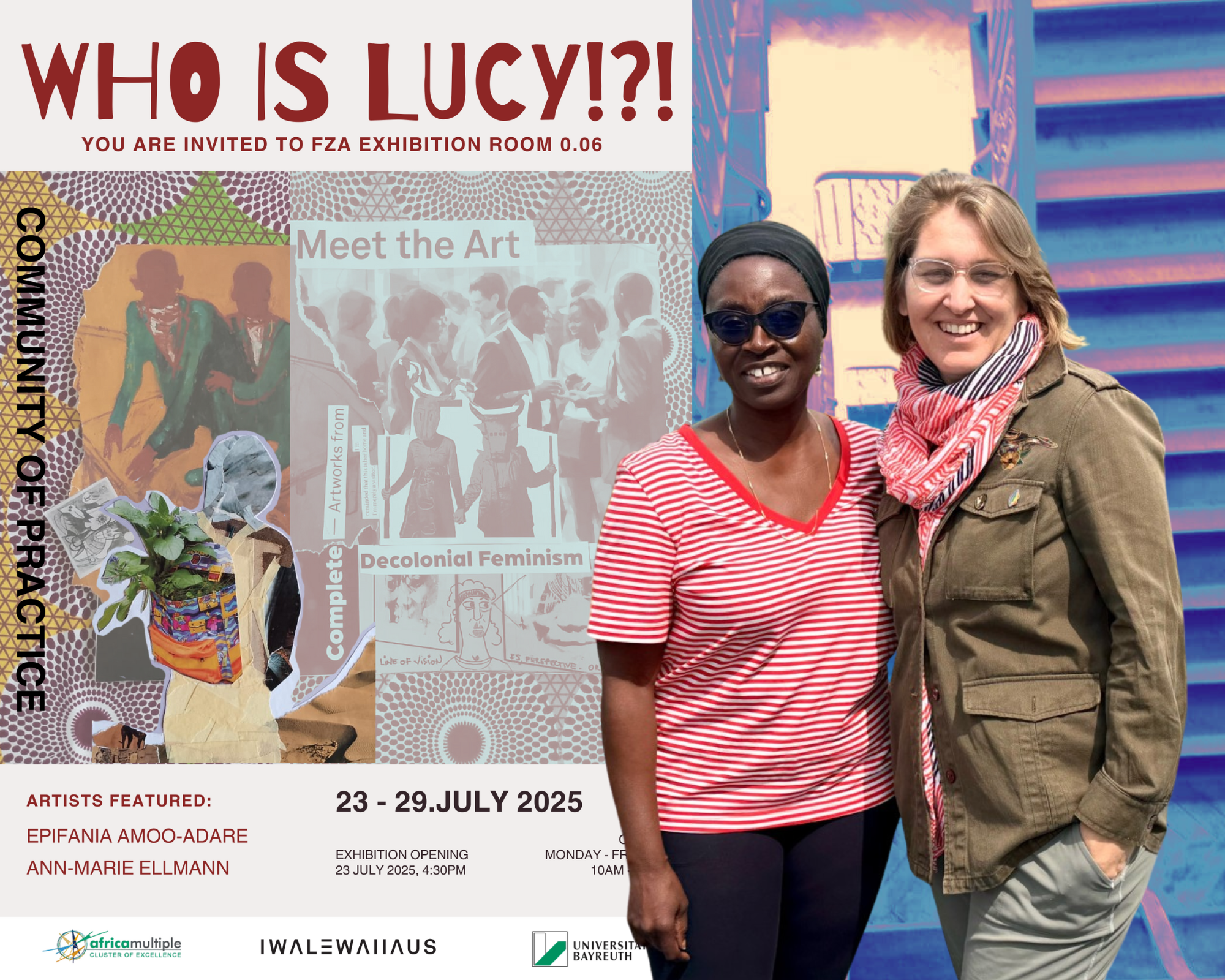
Epifania Akosua Amoo-Adare and Ann-Marie Ellmann van Rhyn reflect on their residency at the Africa Multiple Cluster of Excellence and the development of their installation Who is Lucy!?, presented at the conclusion of their stay.
by Epifania Akosua Amoo-Adare and
Ann-Marie Ellmann van Rhyn
What makes you, you?
What makes me, me?
What makes us, us?
Questions to grapple with, daily,
both in and out of the context of Africa and its multiple globalizations
What separates or distinguishes us from each other?
What unites or brings us together?
And while thinking in this vein,
just who is an African?
It has been all of seven months since we had the opportunity to co-create the art exhibition “Who is Lucy!?! African Wo|Mxn Native|Other”, under the excellent hosting of Dr. Christine Vogt-William, Director of the Gender and Diversity Office. The exhibition was held from 23–29 July 2025 at FZA in the University of Bayreuth, courtesy of the Africa Multiple Cluster of Excellence Artist Fellowship Program – with additional support from Iwalewahaus.
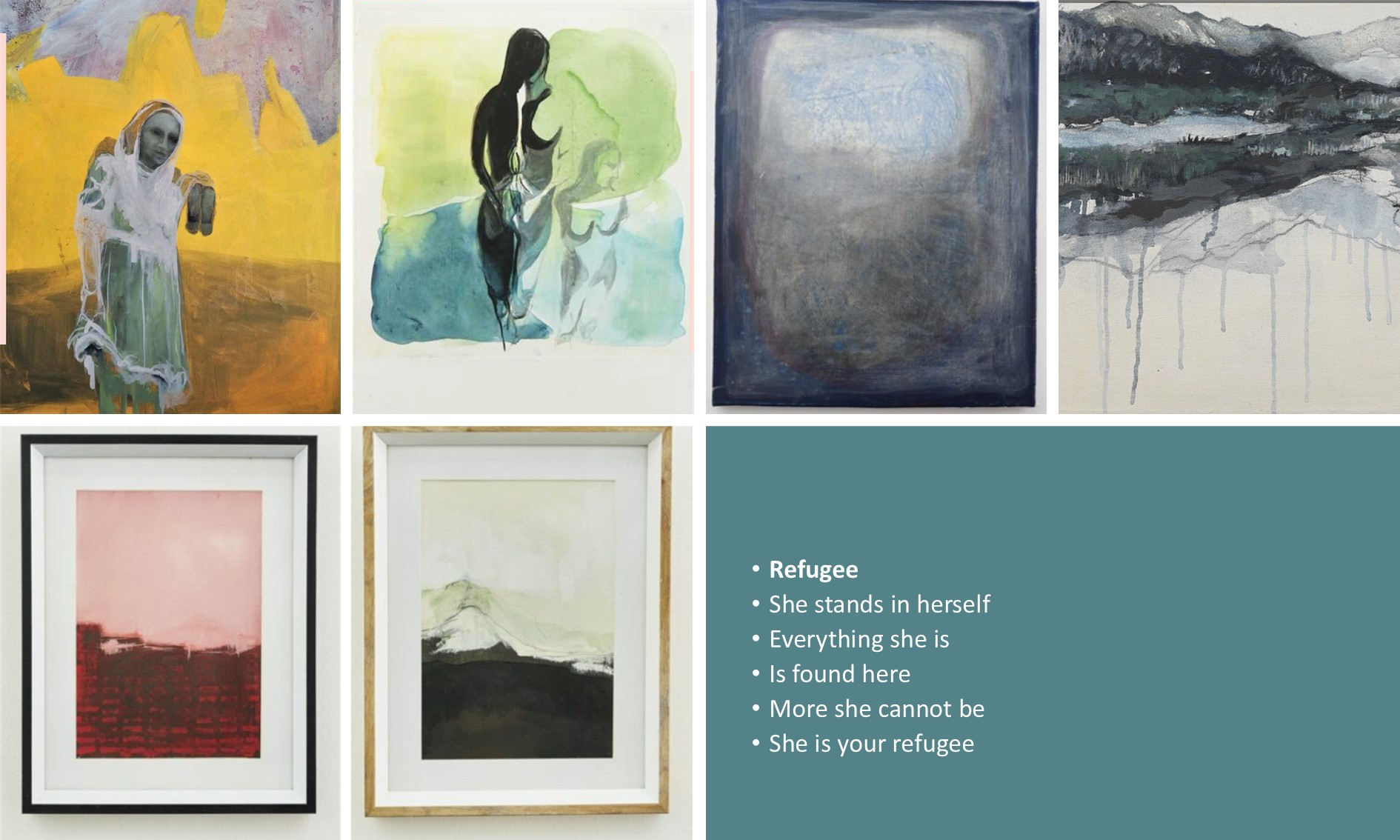
The art installation was a sensory experience, co-created as a community of practice through an involved process that included the use of interviews, focus group discussions, and collective collage making, as well as individual and tandem art-making using textile, audiovisual and digital mediums. The installation was the culmination of a three-month tandem-artist fellowship in the Cluster, within which we had the unique opportunity to work together in-person on a decolonial feminist art project.
Our gratitude to the Cluster knows no bounds as it has given us precious (breathing) space to not only imagine, vision, investigate, create, and make an evidence-based art installation, but now also the possibility to reflect upon that art collaboration – its rationale, contours and possibilities for further art-making collaboration in the future. To this end, we offer here the anatomy of our exhibition – even as we also recognize this to be an impossible task, due to the inherent inability to truly capture the essence of fluid and dynamic lived experience within the fixed and linear confines of the written text.
standing in m-othering,
the filters of others
moves through us, over us and under us
gene coded:
residue of our many grandmothers’ bloodline
leaving traces on our bodies
as we slip through each mother’s birth canal,
w/ God-given souls intact,
facing the world
in readiness for our father’s naming
of our character, into existence
such ceremony brings the unborn
in touch with the living
under the watchful eye of the ancestral –
dearly departed
we are here
excavating our mother’s, mother’s, mother’s, mother’s, mother’s, mother’s, mother’s
(ad infinitum)
m-Other
rather
unceremoniously.
The title for our exhibition was as important as the artwork itself. To start with, we had in it our key question: “Who is Lucy!?!”; this, referring to our human ancestor Lucy, a 3.2-million-year-old fossilized skeleton of Australopithecus afarensis who was ‘discovered’ near Hadar, in the Afar Triangle region of Ethiopia, in 1974. The name Lucy was given to our human ancestor by the discovery team, as they were playing the 1967 Beatles track “Lucy in the Sky with Diamonds” at the time of their finding of her. In more recent time, Lucy has been given an Amharic name Dink’inesh (ድንቅነሽ) – which means “you are marvelous” or “you are unique” – in a bid to reclaim our ancestor’s own agentic heritage from inside out vs outside in.
Ultimately, we asked the question: Who is Lucy!?! because we wanted to better understand in both an intellectual and visceral way this simple cogent question: What does it mean to excavate one’s own origin African mother, desecrate her grave, and further still subject her to analytical scrutiny, all so as to find one’s own self?
Basically, how does one ‘discover’ our collective and individual African identity, when some might argue that such an action is tantamount to seeking what already simply exists, is always there, and should to all extents and purposes be somehow deeply embedded within each and every one of us? This being as genetic code, biological memory, and even potentially metaphysical essence that resides in us all (if you are prone to believe in reincarnation). After all, it is said that on the physical plane we breathe the very air that all our ancestors drew first breath from, just as we also drink the same water that has passed through their biological systems, as well as that of all flora and fauna. Consequently, dust to dust and all kinds of epigenetic considerations remain uber significant in our enquiry, even with the current turn to Artificial Intelligence.
Aside from the significant title, we also selected our subtitle “African Wo|mxn Native|Other” purposefully. Our subtitle was a nod to Trinh T. Minh-ha and her 1989 text “Woman, Native, Other: Writing Postcoloniality & Feminism”. In this seminal work, Minh-ha utilizes literary criticism, feminist theory, anthropology and oral storytelling to question western male-centred ways of knowing and representing identity. She does so by problematizing binaries, while exploring displacement, fragmented selves, and multiple identities lived in postcolonial contexts in lyrical and non-linear ways.
Through this work, Minh-ha provides us with an invitation to rethink how we talk, represent and write about identity, culture and gender. She asks us, as “writing women” (i.e., as active creative subjects), to then participate in a decolonial feminist rewriting; one in which we engage in the challenging, undoing and reimagining of dominant narratives, categories and systems of knowledge shaped by colonialism, patriarchy and Eurocentrism.
Just as Minh-ha argues for the questioning of western male-centred ways of knowing and representing, we too wished to question the often male-centred representations of who is assumed to be African; hence our use of the subtitle “African Wo|mxn Native|Other”. Moreover, utilizing an intersectional feminist perspective, we also wanted to challenge notions of who is also considered to be a woman; hence the use of the spelling womxn to include diverse gender identities (e.g., trans and non-binary identities) into this heterogenous gender category.
Both you and I,
come out of Africa
and yet
all of us are infantilized by gender, race, class, sexuality and other states of stratification,
which even intersectionality cannot save us from.
We’ve been perched precariously
on that anachronistic family Tree of Life –
it moves us from dark to light,
and the colonizer is keeping the conversation going;
it moves us from backwardness to civilization
and the colonizer is keeping the conversation going;
it moves us from nature to culture
and the colonizer is keeping the conversation going;
it moves us from illiterate to western educated
and the colonizer is keeping the conversation going
in one too many patronizing saviour mentalities
and before you know it, that colonizer is in fact you too:
you whose privilege has become your loss
of language
of culture
of worldview
of sense of style
of philosophy of life
of cosmological difference,
as we all now exist in epistemological exigencies of progress, in a certain Cartesian ontology—a hierarchical binarity that has with grand narratives forgotten its own indigeneity.
Taking into account the numerous subtexts identified in our exhibition title and subtitle alone, during the fellowship, we embarked on a potentially suicidal mission to try to interrogate the extreme tensions within what it potentially means to be an African, or otherwise. More specifically, we sought to explore the idea of Africa and its many diverse identities through various conceptualizations as follows:
- Africa as origins – cradle of civilization, as well as the last frontier for globalization.
- Africa as relationality – with encounters among ourselves on the continent, encounters with and among the African diaspora (i.e., Africa-in-globalization, from the Americas, to Eurasia, to the Pacific Islands, and beyond), and then also encounters with (so-called) everyone else.
- Africa as multiplicity – with the largest land mass, 54 countries, over 2000 languages, the highest genetic diversity, and so on.
- Africa as chaos and complexity, as much as it is about the persistent (and historic) order in the constant disorder.
- Africa as fluidity and mobility, as much as it is about rootedness, homesteading and homegoing
- Africa as commitment – to the “struggle is real” and Black Lives Matter always.
- Africa as political contingency – for reparations, atonement, and reconciliation.
- Africa as strategic essentialism – the continued need for fabricated standpoints to account for colonial and apartheid histories and their contemporary effects within the current “colonial matrix of power”, but also the importance of dismantling such fundamentalisms once they have served their specific purpose.
- Africa as contradiction – new and old, rich and poor, materialistic and spiritual, etc.; thus, Africa as the original trickster: in its liminality of becoming both this and that, being both/and versus simply either/or.
- Africa as uncertainty and, ultimately, extensive possibility for futuring.
Ultimately, we sought to explore Africa in all of its dynamic, unfolding and embodied existences, far beyond binaries, especially in light of the continent’s plural geography, biology, ideology, ontology, epistemology, cosmology, philosophy, etc. In other words, we were interrogating the multiple facets of how Africa is continuously both process and state, becoming and being. Therefore, Africa is, just as it also is not. This is something we learn through the ambiguity within proverbs, symbology, song and other cultural practices, which demonstrate how we should be able to hold such contradictory ideas in our heads without the implosion that comes with cognitive dissonance.
Bright souls in a dark world:
we who cannot be taught to be African
simply because
we are a culmination of embodied living
beyond this single story, beyond even the greatest story ever told
all of us—in polyphonic multiplicity, both|and:
being within becoming,
states embedded in processes,
allow it to constantly unfurl
embrace this contradiction
now
and
always,
you who are a frequency the world cannot predict.
Yet still
need
to be heard
to be seen
to be felt
to belong
when
all we have is one another.
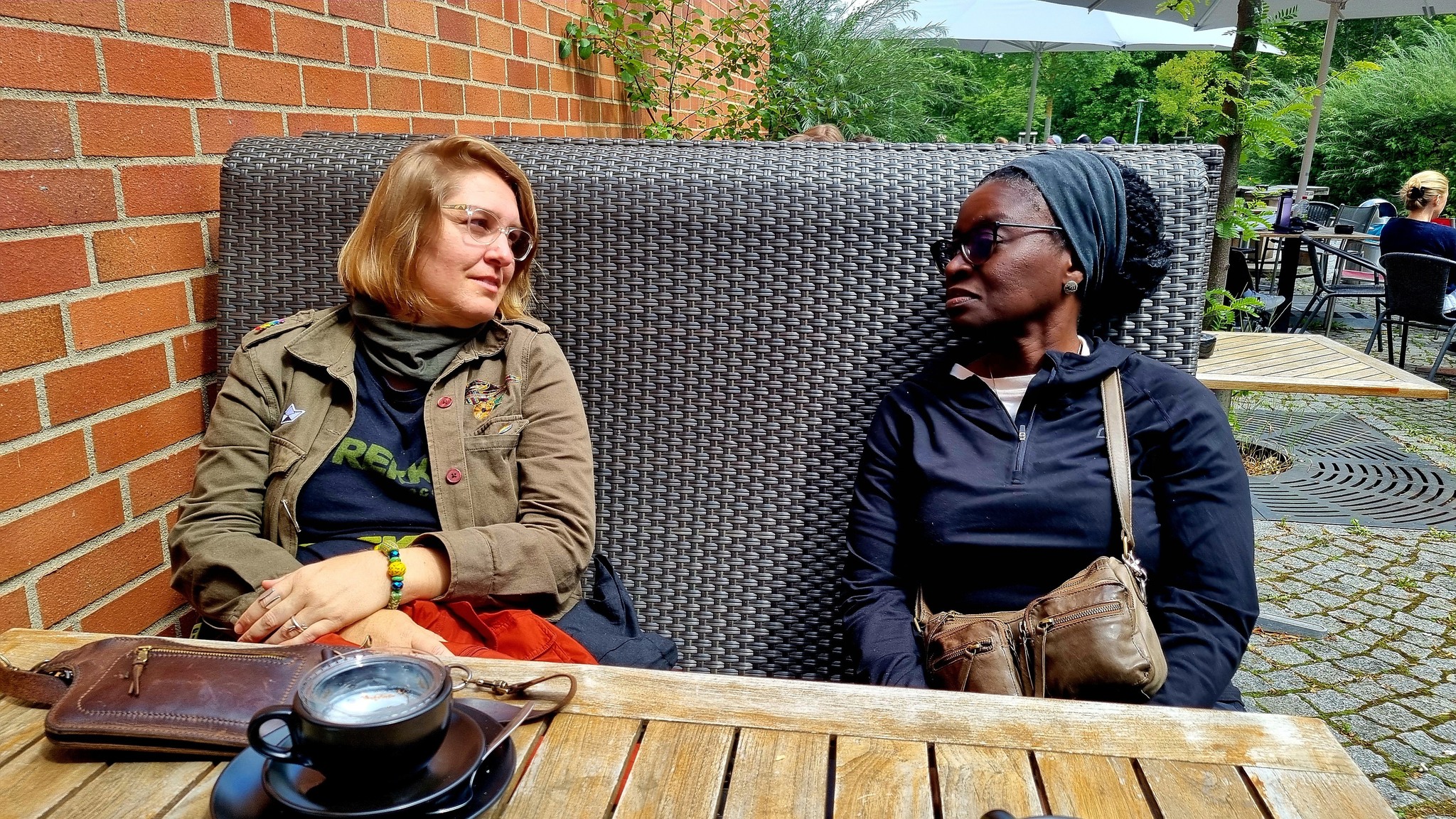
In Bayreuth, our artmaking for the final exhibition was instigated through our relationship with each other, with the spaces we inhabited during the fellowship, with our ideas on the topic (who is African), with our peculiar and particular auto-biographies, plus with the conversations we had with individuals and in groups; i.e., people associated with the Africa Multiple Cluster, Iwalewahaus, BIGSAS and the wider Bayreuth community.
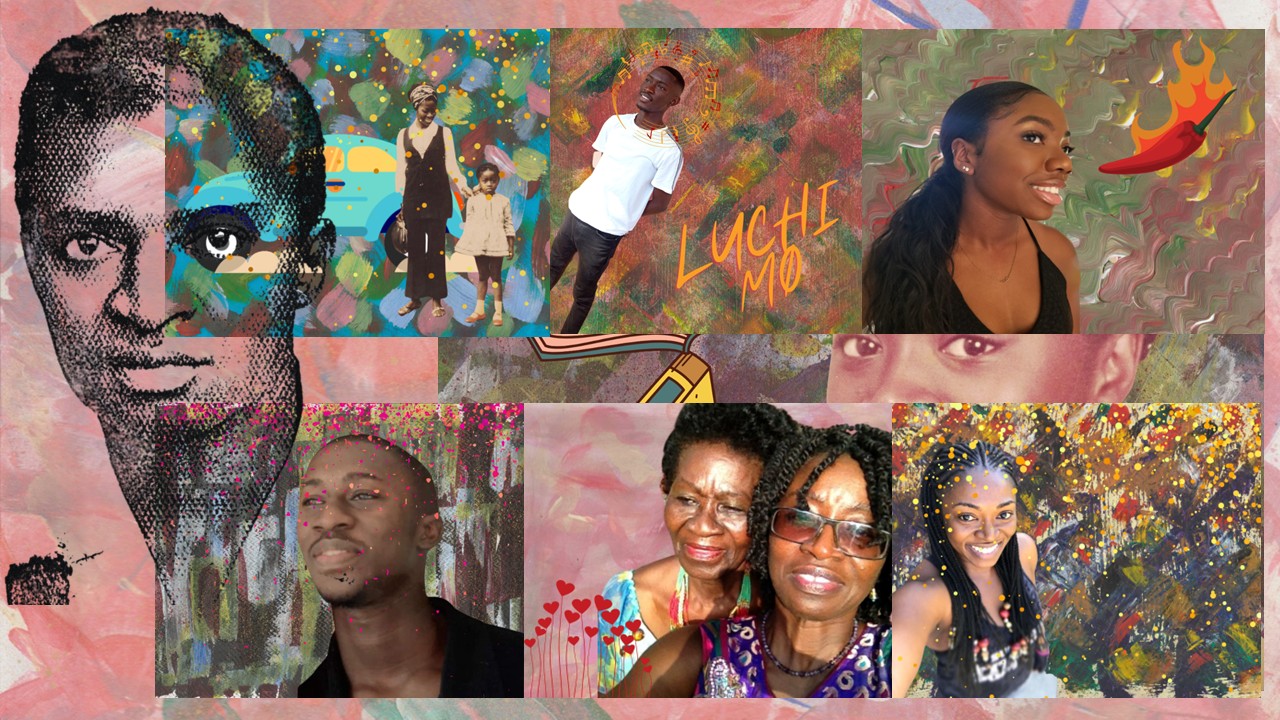
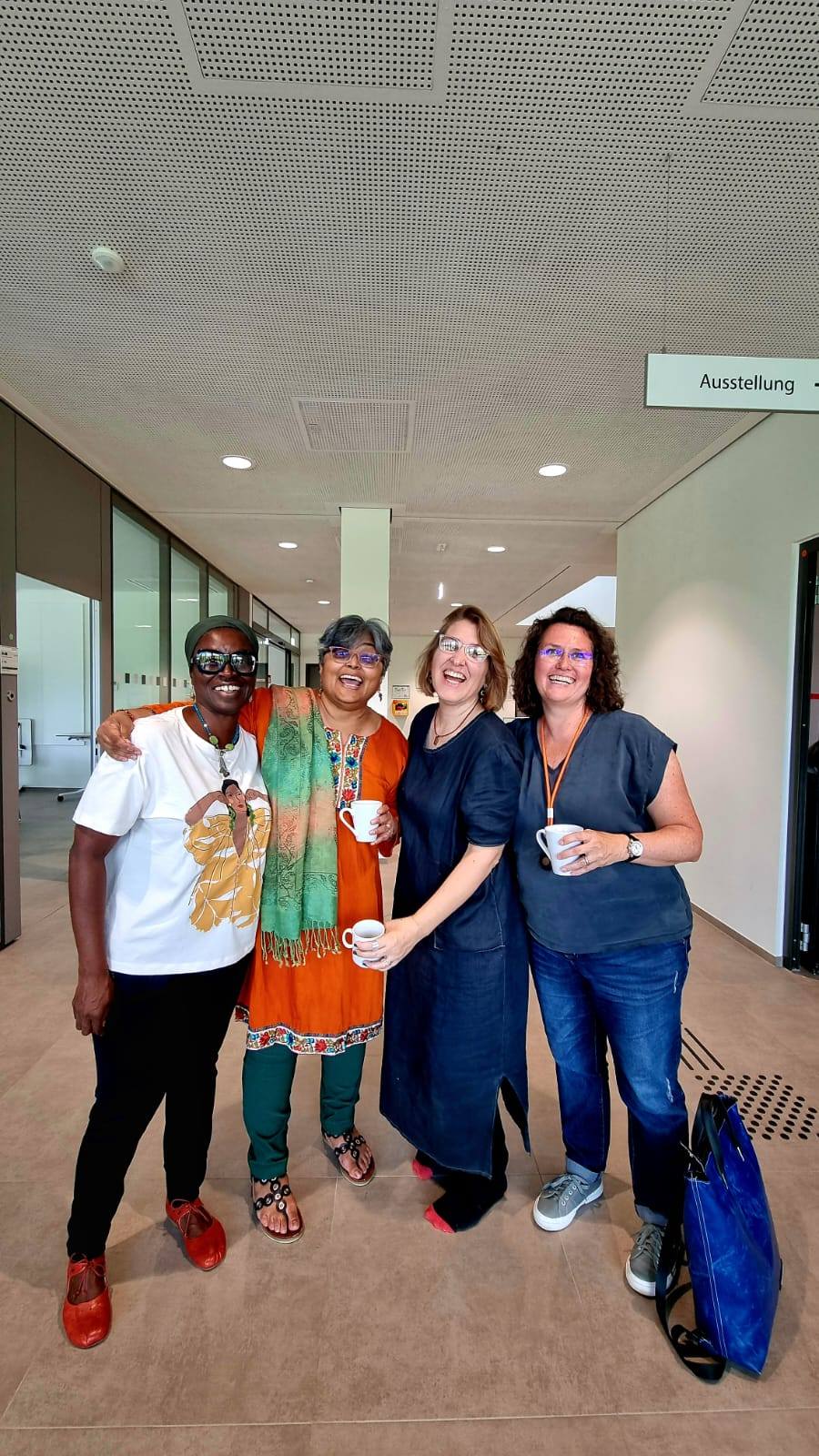
Altogether, we interviewed 20 people (six on the African continent and 14 abroad) in sessions that lasted between one to three hours. We also conducted three discussion and collage making group sessions: 1) with 15 grade nine to ten students (and their teacher) in Gymnasium Christian Ernestium school, 2) with seven people from Iwalewahaus, and 3) with four individuals from the Africa Multiple Cluster international fellows’ program.
We found that the discussions that unfolded in these groups, along with the very personal stories shared during the one-to-one interviews, were deeply inflected in both of our hearts and minds, especially as we attempted to adequately express them in our textile, audiovisual and digital artmaking for the final installation, without misrepresentation and/or the silencing of anyone.
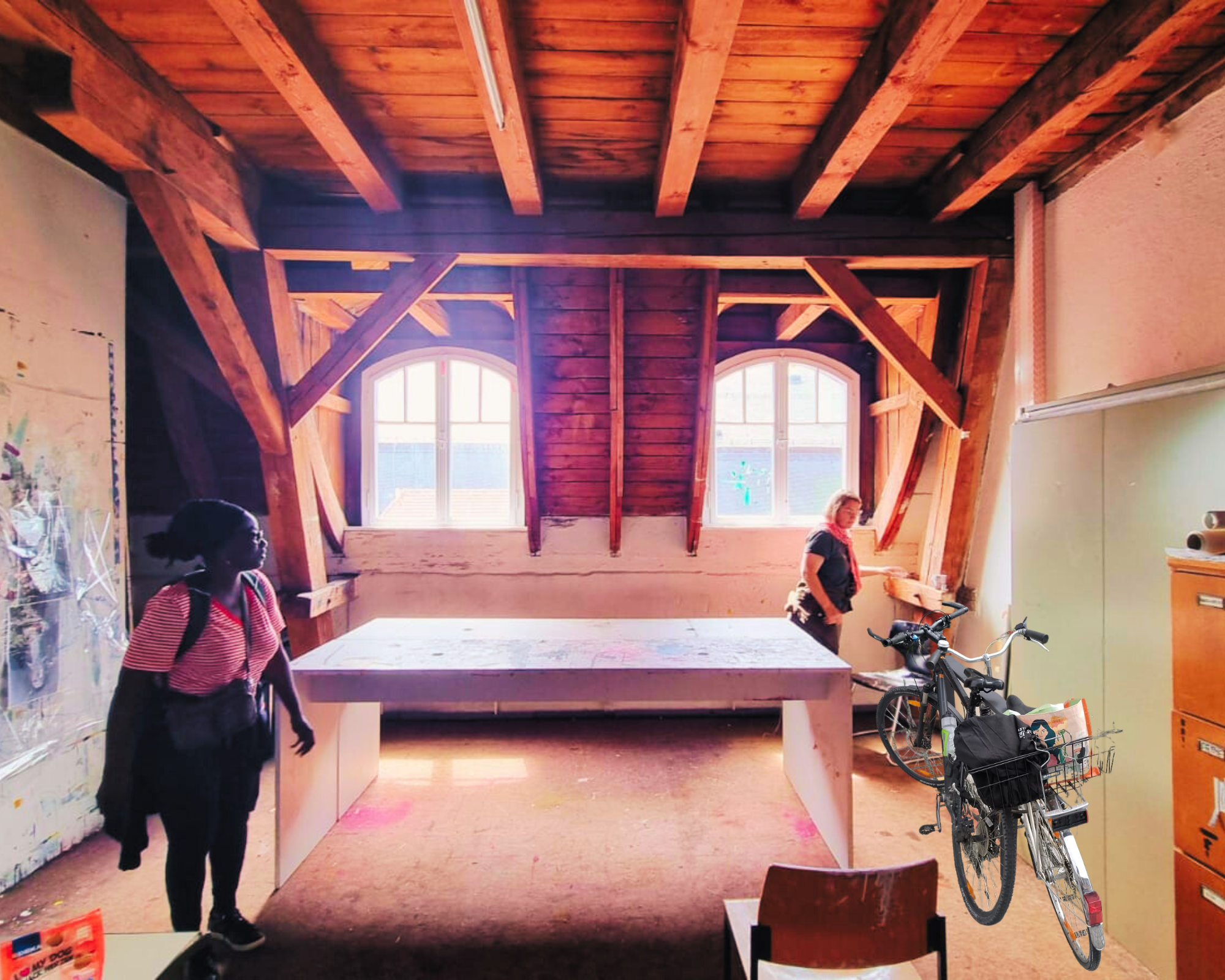
We were (and still are) exceptionally thankful for what fast became a budding community of practice that contributed daily to our interpretation of the data we gathered, the creation and production of our individual and tandem artwork, and the very making of our being, while we also negotiated the numerous administrative, institutional, financial and spatial1 hurdles, as well as our own joy, anticipation, doubts, desires and fears about how best to illustrate that we are, or (in fact) are not, to varying degrees African.
Our underlying anxieties then, and even still now, are rooted in our own personal trajectories of being both insiders and outsiders to all people, places and things African. Here, we speak to the fact that Epifania, being of Asante descent, appears to be phenotypically African and yet she was born in the United Kingdom and lived abroad mostly – making her a questionable subject when it comes to ease of habitus and fluidity of cultural practice in Ghana. Whereas, Ann-Marie was born and has always resided in South Africa; accidentally, being Afrikaans, and not speaking her ancestor’s language, becoming like Epifania a means of an ascription of a particular kind of person that is reflected in the larger culture.
This issue of race as a “floating signifier” (Hall, 1997) then means that we came to our collaborative work with an “incongruous relationality”, especially if we were to take into account the racist-sexist binary identities imbued in colonial and apartheid history, as well as in late capitalism; thus, inflecting our ever-evolving friendship and working relationship.
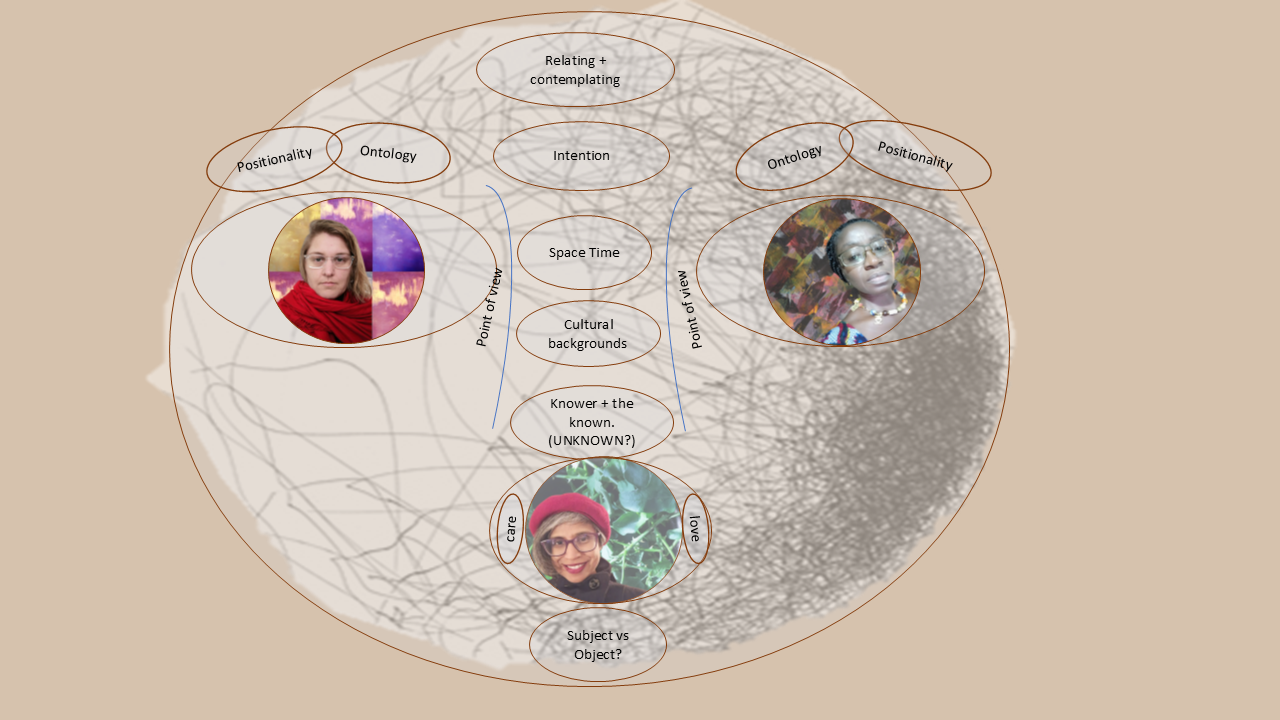
Trying to understand the implications of this incongruous relationality led us to the development of a relational ontology that acknowledges that knowing one’s self is also about being seen and/or identified by the other. More specifically, this ontology of ours is comprised of several categories that speak to our friendship and are described as follows:
- Relating and Contemplating: our insistence on relating in order to contemplate life as we know it individually, but also collectively.
- Intention: our intention to get to know each other across borders (both real and of the mind), in spite of certain identity politics, while also connecting with others so as to become part of the creation of a new (more just and equitable) world.
- Space-time: our relationship, forged over six-plus years, being one developed across distant geographies with our various emplacements in South Africa, Ghana and the UK, as well as that of Germany and Sri Lanka for a third co-conspirator (Rapti Siriwardane-de Zoysa), who is an integral part of our collective engagement.
- Cultural Backgrounds: our relationship building persists through our negotiation of diverse cultural backgrounds (Ghanaian, British, South African, Sri Lankan and/or German), i.e., our own and that of those we have also encountered through our many travels.
- Knower and the Known (and Unknown): our understanding that there is a deep, unabiding, yet potentially resonate and fulfilling relationship between the knower and the subject to be known, plus more so nowadays the unknown.
- Care and Love: most importantly our relationship is held together by the love and burden of care that we choose to cultivate amongst ourselves and with others; thus, decolonial and divine love is at the centre of our encounters, as we try to find ways to learn to be unconditional love.
- Subject vs Object: ultimately with love, there can be no subject in contrast to an object of study – as after all, we are one planet, one multiverse, one throbbing and pulsating reality.
Ultimately, relating with each other in these ways also requires the purposeful interrogation of our various positionalities, i.e., the privileges and power that each of us is privy too as a consequence of location of birth, family ties, marital and other affiliations, the social capital we either inhabit or create for ourselves, the educational institutions we gain access to, etc. and so forth. We do this interrogation constantly, so as to develop a new kind of ontology of relating, thus becoming – one that is both post-oppositional and embracing, as it is critical and consciousness raising.
Consequently, all our interactions in Bayreuth for the project, and everyday living, were mediated by this understanding of relationality. It informed the level of love and care with which we 1) interviewed individuals, holding their sacred personal stories with gentleness and care; 2) held group discussions and collaborative collage-making, in orchestrated safe spaces; 3) negotiated administrative, institutional, financial and spatial hurdles, always seeking harmonious resolutions to conflict; 4) created our artwork, often ensuring that our efforts were collaborative and oriented towards limited wastage, thus, sustainability; and 5) generally navigated our way through the city, always with light-heartedness and laughter.
Could it be then, that we are all very much African
and yet, simultaneously, not?
But then there is the small print:
you can only be African, if you show your commitment
to the cause
(beyond basking in the beauty and joy of the continent and its diaspora)
you must show real commitment
to the pain
to the persecution
to the persistent penury
to the determination to end all kinds of “shuffering and shmiling”
you must show real commitment
to the need for truth and reconciliation
to the calls for reparation
and ultimately to an acceptance of the value of Black Lives over and above only loving our music, fashion and culture.
All so as
to fight the systems (of discrimination, of division in difference, of diversity without inclusion);
you must no longer feed them
with your energy,
for “we are
because I am”,
since “you are my other me”.
In putting the installation together, based on our findings, we were not interested in providing “art as exhibit” but rather “art as creative everyday practice with relevance for ordinary matters”. We were also interested in creating “art as ritual practice”; i.e., as magical and sacred acts that are also incredibly mundane in the experience of them. Ultimately, we were determined to engage in art as process versus product; thus, we viewed the art to be the process of everything that took place in relation to our project, during our three months in Bayreuth, as opposed to only what was in-state in the art exhibition. The main aim for us was that the fruits of our labour and engagement, through our community of practice, be reflected in the exhibition we installed with the help of the community.
Key to this endeavour, was the need to communion with others in the Cluster and beyond in order to get a deeper sense of what moves thinking on the question of who is African, if at all anyone. But time is required for real community to develop, because communion requires trust for deep observation and understanding of each other to occur. Still, we believe that in the brief period of three months, we were able to foment a budding community of practice through our various planned and unexpected communion with people from FZA, Iwalewahaus, the Gymnasium Christian Ernestinum school, and the wider Bayreuth environment.
Communion was also about both of us too: how we worked together in a strange land (especially during the adverse moments), whether we were in sync; how we sought harmony of ideas, but also recognized the need to allow for discord, difference and the sovereignty of own peculiar modes of thinking, being, doing, artmaking, worlding, etc.; how we supported each other in our joint (and at times separated) art practice but also allowed each other room to fail forward; and so on. During the fellowship, we realised that we were moving and working with a lens of friendship; that is, being friends to one another but also to the larger community. Engaging in such a practice was somewhat different from the professional academic environment we had come to know and had previously worked within.
Additionally, we found that there were degrees of relationality: between us two, amongst us and the people we conversed with through informal chats, interviews and focus group discussions; between us and the institutional positionalities (personalized, professional and otherwise) with which we worked; and between each of us and the knowledge and art mediums with which we grappled.
A key question that arose through this process was: When art is done as a community of practice, what becomes of the art? What too happens to the notion of artist?
In trying to answer these questions, we found that compromise and creativity became the name of the game. Basically we, as the artists or curators, were tasked with learning when was appropriate to push for our vision of the work versus when to concede and mould our art practice, medium, concept and/or ideas into a new form being demanded for by the other stakeholders, actors and/or the environment (i.e., the institutions, the wider community, the material context, etc.). This required letting go of notions of “art as perfection” or “artist as expert”.
With such a praxis, the awareness of when personal and institutional egos come to the fore is very strong and it soon becomes very clear who believes in the artist’s mission, who is just there for the ride, who is waiting to sniff out failure, who is for the art versus their fiefdom (and its bureaucracies, politics, etc.), and/or who is for both the art and the fiefdom (i.e., when there is a confluence of interest). How we handled those moments was critical for the developing relationships in the community of practice and for how we understood and interpreted our roles as artist-scientists – if we even cared to use and/or wear such confining labels.
It follows then that intimacy was also an experience that we wanted to muster. It is why we used cultural artifacts as the entry point into people’s lives, during our interviews - where we asked each person to bring a cultural artifact that represented an important aspect of his or her life. Basically, a higher level of intimacy was reached during our conversations, just by each person sharing the significance of his/her chosen artifact in her/his life. In rapid time, we found that we were afforded to know what mattered to each person at an affective level versus through the use of more superficial question patterns such as where do you come from, where did you study, where do you work, etc.
In addition, vulnerability (and how to handle it with care and love) was also a topic of interest to us, especially in terms of exposing both of our own vulnerabilities as well as the fragility of our ideas, the institutions, and notions about Africanness, thus, who belongs. This being through the tension that arose because of what each one may perceive, which can also be projected or received adversely. There was then the friction of misunderstandings in language or cultural norms to be tackled by listening (and also acknowledging) the tensions.
There were of course also many degrees of multiplicity: in art mediums (digital and analogue), voices, perspectives, personalities, imagery, ideologies, politics, ideas, world views, and so on. This we saw as being what Africa is about: complexity, chaos and contradiction.
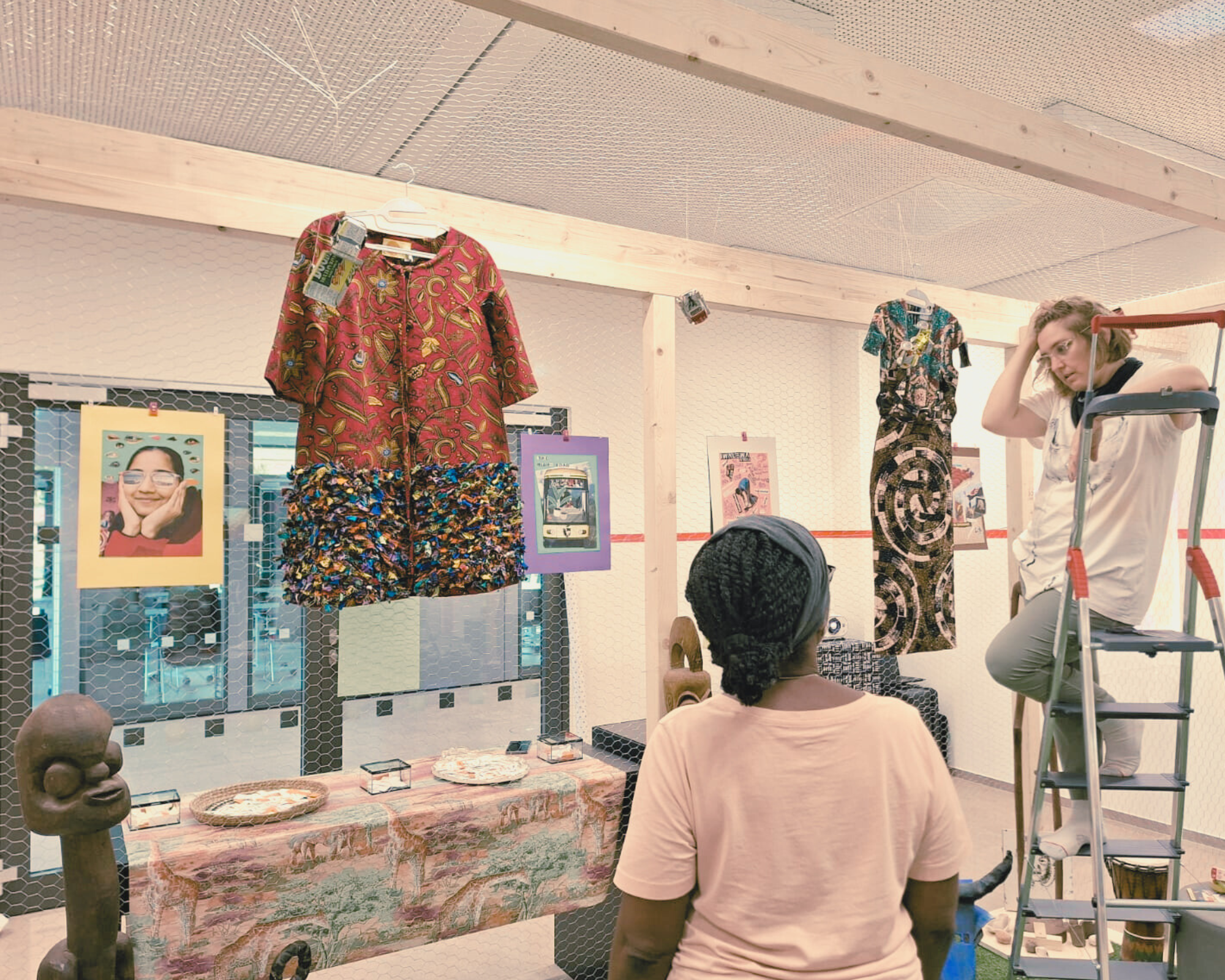
This then meant contradiction was also a key concept for our project; that is, finding ways to demonstrate that it is possible to hold two opposing ideas (beliefs even) in one’s head without necessarily exploding and/or imploding. It is why our exhibition played with notions of ephemerality (video being projected onto sheer white curtain fabric) and fixity (the large central structure and other fixities); thus, we also played with fluid and solid, movement and stillness, at the same time. It is why both digital (the videos) and analogue (the curtains, posters, postcard collages, found art objects, and sacred space) come into play. The contradiction was also designed into the use of the space by the participants/visitors, who were to engage, observe, move or settle; thus, allowing contradiction to expand beyond the binary ideas of one versus the other.
Tension was also critical in what we wished to represent. Basically, the constant push and pull, a tugging of our very being if you will – represented for us by the sleepless nights spent in doubt about our ideas and the capacity to express the magnitude of what we were learning through the art-based inquiry process.
In the final installation, we worked to achieve an expression of the various tensions we encountered. We did this through the use of the following devices:
- contrast (e.g., placing the sacred alongside the mundane in the central video station, or by the presentation of both ‘good’ and ‘bad’ personalities in our ancestor posters, etc.),
- spatial positioning (e.g., placing the central sacred structure off centre, insisting that the audience remove their shoes to walk onto the faux grass in the sacred space, or forcing the audience to have to look up at the ancestor posters in the shrine, etc.), and
- cognitive dissonance (e.g., having an audio text that does not match the images of the video, or video with no sound, etc.).
The central purpose of all these devices was to create a slight and perhaps constantly jarring feeling, thus, embodying the underlying sense of tension that is endemic in any understanding of what it means to be African, if this is even at all possible to comprehend.
All time is ours
and yet
we can’t keep sleepwalking through this nightmare of day dreaming
and, of course, there are always way more questions than answers
so very many of them reside in the endless unknown
plaguing us into this persistence of inquiry.
The fellowship left us with the clear understanding that the African continent provides unfolding rather than conclusions. Therefore, there are way more questions than answers, way more flights of fancy, and way more knowledge to explore – lines of inquiry with no end. Much of this, we now struggle to attend to – having lost the precious (breathing) space and time to dig deep into the significant data we collected.
To all extents and purposes, we would love to analyse the data more thoroughly – enabling us to do another (more academic) writing of what we found. At the same time, we also want to expand the study by interviewing more people (especially on/of/from the continent) and conducting more focus group discussions and collage-making sessions, so as to create other installations based on new findings in different locations.
But this remains a pipe dream for now, as reality’s daylight robs us daily of time – due to the reproductive and productive labour that abounds in the life of the average African womxn. In our case, issues to do with a general loss of time for doing deep work, because of being absorbed by itinerant, precarious and/or unpredictable contract work, as well as having to spend time on elderly care and many other domestic considerations. Still, we are optimistic and determined, thus, sneak a moment here and there to continue this work. And this reflection is a reminder of how much there is still to do and also how little justice writing about it does to our ability to express the expansive reality of it all.
Where there is doubt,
there is also the movement
of enquiry.
And
once you doubt it,
then, you must continue to enquire!
- Find more on the artists here: Epifania Akosua Amoo-Adare and Ann-Marie Ellmann van Rhyn