

Important Dates

New Year Lecture 2027
21.01.2027
FZA Congress Room
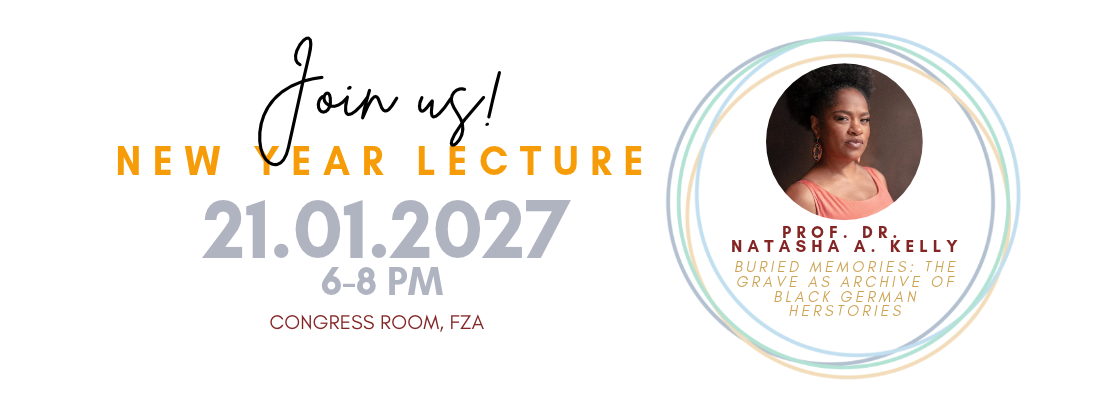
Buried Memories: The Grave as Archive of Black German Herstories
by Prof. Dr. Natasha A. Kelly
The historical presence of Black women in Germany has often been marginalized, romanticized, or erased from dominant historical narratives. In some cases, gravestones, burial records, and fragmented archival references constitute the few remaining traces of their existence. Yet graves are more than places of burial. Through inscriptions, names, symbols, and visual representations, they become sites of remembrance where the lives of the deceased are made visible, interpreted, and inscribed into collective memory.
Taking the histories of Black women such as Alzire in eighteenth-century Bayreuth, Machbuba in nineteenth-century Bad Muskau, Jambga in nineteenth-century Cologne, and the Black German poet and activist May Ayim in twentieth-century Berlin as its starting point, this lecture examines the grave as a material, visual, and ontological site of Black presence in Germany. Their different histories of remembrance — from colonial romanticization and the disappearance of burial sites to collective practices of care and commemoration — reveal how racialized and gendered power relations shape not only what is remembered, but also whose existence continues to be publicly acknowledged after death.
Drawing on Black feminist and decolonial approaches to memory and archival knowledge production, the lecture explores how fragmented histories are refracted through material traces, visual representations, and practices of remembrance, challenging inherited narratives and opening new perspectives on Black German herstories. It further considers what a cartography of Black women's graves might reveal about their historical presence across Germany, tracing not only existing burial sites but also those that have disappeared or been transformed over time.
"Buried Memories" proposes the grave as a site of historical knowledge production and an expression of the continuing relationship between the living and the dead. By bringing historical research into dialogue with artistic and curatorial practices, the lecture explores how Black German herstories can be made visible beyond the limitations of conventional archives, opening new perspectives on memory, belonging, transformation, and world-making.